NEWS
Dump Foreign Frameworks, Embrace Sàngó and Ogun Oaths for Ethical Governance — Falola
Published on Wed 15 Jul 2026 By Akintayo Asamu
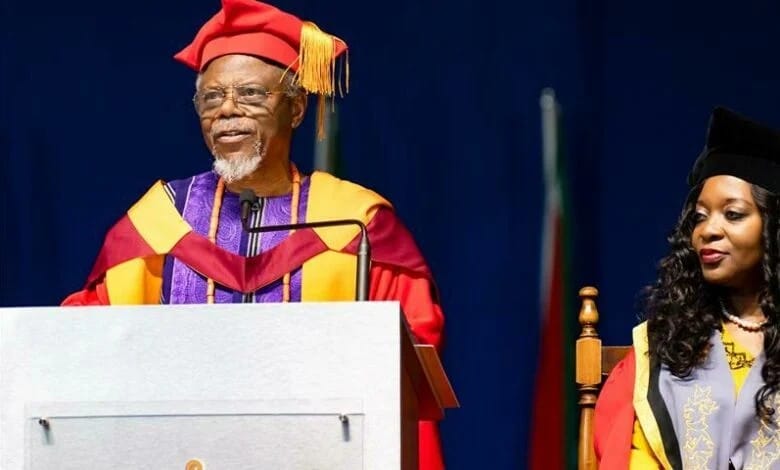
 Renowned historian and Professor of African Studies, Toyin Falola, has urged the National Assembly to integrate Yoruba deities, Sàngó and Ògún, into the official oath of office for public servants to tackle endemic corruption and leadership abuse.

Falola argued that the spiritual dread of indigenous deities could enforce public accountability far better than Western-styled constitutional frameworks, which politicians violate with impunity.

He spoke while delivering a keynote lecture titled, “Yorùbá Mythologies and Their Relevance Today,” at the inauguration of the Alaafin Institute of Yoruba Studies, Emmanuel Alayande University of Education, Oyo.

The scholar questioned why Nigeria’s elaborate legal architecture consistently fails to deter corrupt officials, attributing it to a lack of moral and cultural legitimacy among the populace.

"To decolonise corruption, impunity, and abuse of office, what prevents our National Assembly from incorporating the nemesis of Sàngó into the Oath of Office for all, regardless of their religious faith?" Falola asked.

"I wonder if any Nigerian politician could withstand the wrath of Ògún and Sàngó as they violate with impunity the letters and spirit of Western laws."

He clarified that his proposition is not a call to dismantle democracy or return to pre-colonial monarchies. Instead, he urged policymakers to extract indigenous philosophical tools to fix modern institutional failures.

The Power of ‘Àṣẹ’

Drawing from traditional Yoruba political thought, Falola noted that leadership authority is historically anchored on àṣẹ—a concept of spiritual power deeply tied to moral rectitude.

"A monarch who does not act with the character appropriate to a man who bears divine power loses, by that very failing, the àṣẹ that makes his authority real," he explained. "Power without a moral basis is not authority but coercion."

He pointed out that long before Western democracy arrived, institutions like the Ọọ̀ni and the Aláàfin operated under strict frameworks of accountability. In extreme cases of ethical failure, traditional councils could invite erratic kings to "open the calabash"—a ritualized demand to commit suicide.

"These were not ideal systems, but they embody a political understanding about the link between power and responsibility that the post-colonial Nigerian state has spectacularly failed to institutionalise," Falola said.

Beyond Structural Reforms

The professor maintained that decades of constitutional amendments, electoral overhauls, and structural adjustments have yielded little fruit because they ignore the ethical foundations of leadership.

He cautioned against treating Western constitutional democracy as a universally flawless template, noting that it evolved out of specific historical realities in 17th and 18th-century Europe.

"Those ideas aren’t culturally neutral," Falola argued. "They don’t translate seamlessly into contexts that have radically different assumptions about individuality, community, and authority."

He concluded that true good governance will elude Nigeria until its democratic reforms look inward, moving past structural adjustments to embrace cultural legitimacy and deep public accountability.
ADVERTISMENT

You May Also Like