NEWS
Senate seeks review of firearm law to allow citizens own guns
Published on Thu 27 Nov 2025 By Akintayo Asamu
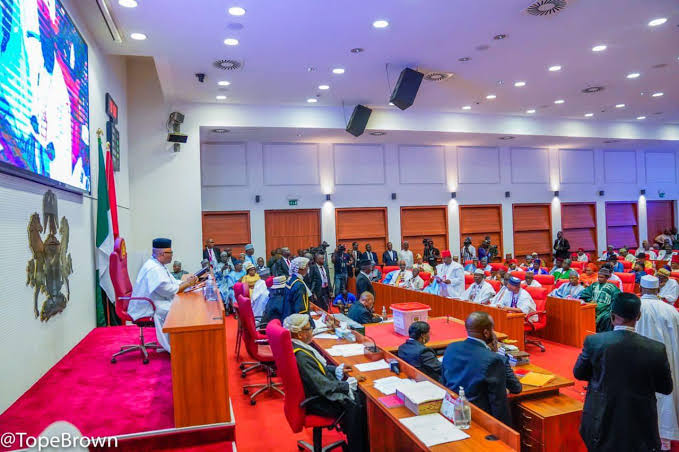
 A resolution urging the Federal Government to review the firearm laws to allow responsible citizens to own guns was yesterday passed by the Senate.

The Red Chamber’s decision was triggered by the escalating insecurity in Kwara, Kebbi and Niger states.

The resolution followed consideration and adoption of a motion titled: “Urgent need to address escalating insecurity in Kwara, Kebbi and Niger States.”


In his lead debate, Deputy Senate Leader Senator Lola Ashiru (APC, Kwara South), who sponsored the motion, highlighted recent attacks on schools, worship centres, and rural communities.

He noted the November 18 attack on Christ Apostolic Church (CAC) in Eruku, Ekiti Local Government Area of Kwara State, where two worshippers were killed and 38 others abducted.
ADVERTISMENT

 In their contributions, senators urged immediate action to curb the rising wave of banditry, kidnapping and violent crimes.

They warned that mass school abductions and persistent raids have forced closures of schools, including 47 unity schools, disrupting the education of thousands of children.

The lawmakers commended President Bola Ahmed Tinubu for cancelling foreign trips to coordinate security responses, which led to the release of 38 abductees in Kwara and the 24 Kebbi schoolgirls.

The Senate also called on communities in the affected states and across Nigeria to remain vigilant, united and supportive of security agencies while resisting internal collaborators who undermine national safety.

According to the senators, the firearm laws should reflect current security challenges, similar to over 175 countries where responsible citizens are permitted to legally own guns.

Expressing concern over the worsening insecurity across the land, they urged the executive to act decisively against terrorists, bandits and kidnappers, who continue to unleash terror on communities.


In their contributions, senators urged immediate action to curb the rising wave of banditry, kidnapping and violent crimes.

They warned that mass school abductions and persistent raids have forced closures of schools, including 47 unity schools, disrupting the education of thousands of children.

The lawmakers commended President Bola Ahmed Tinubu for cancelling foreign trips to coordinate security responses, which led to the release of 38 abductees in Kwara and the 24 Kebbi schoolgirls.

The Senate also called on communities in the affected states and across Nigeria to remain vigilant, united and supportive of security agencies while resisting internal collaborators who undermine national safety.

According to the senators, the firearm laws should reflect current security challenges, similar to over 175 countries where responsible citizens are permitted to legally own guns.

Expressing concern over the worsening insecurity across the land, they urged the executive to act decisively against terrorists, bandits and kidnappers, who continue to unleash terror on communities.

The lawmakers insisted that internal sabotage within security agencies must be investigated without delay.


Enyinnaya Abaribe (Abia South) raised the alarm over alleged security failures, citing Kebbi State Governor Nasir Idris’ revelation that troops were withdrawn from a community shortly before 24 schoolgirls were abducted from Government Girls Comprehensive Secondary School, Maga.

 “What Nigerians want to know is — who ordered the withdrawal?” Abaribe queried.


“If I were the President, I would summon the commander immediately. Someone must account for that decision.”

Adams Oshiomhole, who hailed Tinubu’s commitment to strengthening the armed forces, warned that Nigeria must adopt fresh strategies.

He also demanded the disclosure of the identity of the officer who authorised the withdrawal of troops from the attacked Kebbi school.


Oshiomhole said: “Nigerians are entitled to know who issued that order. The President is doing his best, but we must do things differently.”

Henry Seriake Dickson lamented the killing of Brig.-Gen. Musa Uba by terrorists, describing it as evidence of internal compromise within security operations.

“It is not ordinary to lose a Brigadier-General. Our country is losing prestige, and public trust in military operations is declining.”


Senate Leader, Opeyemi Bamidele, urged swift reforms of Nigeria security architecture, warning that time was running out.

“Yes, we are relieved that 38 abducted victims from Kwara have been rescued, but we are not celebrating — the kidnappers are still roaming free,” Bamidele said.

He added that the Senate must also review and reposition its Committee on Security and Intelligence for greater effectiveness.


Bamidele rejected suggestions that the National Assembly should shut down to signal seriousness, saying such an action would amount to abandoning responsibility.

“This is no time for theatrics. Lives are at stake,” the Senate leader said.


Deputy Senate President Jibrin Barau commended the President’s decisive and sustained efforts toward curbing insecurity. He urged states, corporate bodies and citizens to actively support the ongoing fight.

Barau argued that the security challenges are not the responsibility of the Federal Government alone and require collective action to achieve lasting results.

He said: “Mr. President is doing extremely well. All his efforts should be complemented by all Nigerians – state governments, private organisations, even ordinary citizens.


“This is an issue for every Nigerian to admit and confront. With the trend and effort the President is putting in, we shall surmount this problem.”

He particularly called on state governments to invest in surveillance infrastructure, intelligence channels and operational logistics to support federal security agencies.

According to him, insecurity can be defeated faster if every state builds systems to monitor forests and communities within their jurisdiction.

Barau said: “State governments should help with necessary hardware and surveillance. If each state creates facilities to monitor activities in forests and local areas, the military can respond more effectively.

“When this is replicated nationwide, the results will come quickly.”

Describing Tinubu as “a leader working daily to secure the country,” Barau referenced the President’s decision to shelve his trip to South Africa for the G20 Summit to focus on national security – an action he said contributed to the recent rescue of abducted victims in Kebbi State.


“The President is serious about ending insecurity. He inherited this problem, but he is committed, and with collective support, this challenge will be addressed in a short time,” he added.

On the Senate’s resolutions regarding national security, Barau said the leadership of the Senate would meet with the President to convey the urgency of the decisions taken.

He expressed confidence that Tinubu would give full attention to the recommendations.

Barau also weighed in on renewed calls for state police, stating that the priority should be funding, training and equipping security personnel rather than the label attached to the structure.

“It is not about the nomenclature. Even the federal police need better training and funding – which the President has begun addressing. What matters is capacity, not just naming.” he said.
You May Also Like