NEWS
Bishop Kukah insists no Christian genocide in Nigeria, gives reasons
Published on Mon 01 Dec 2025 By Akintayo Asamu
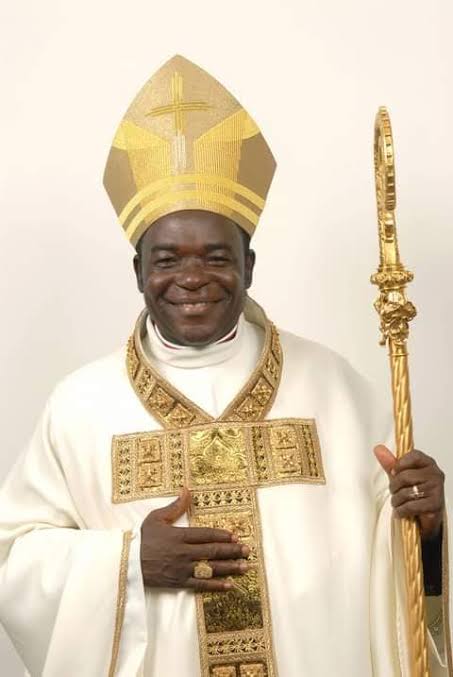
 The Catholic Bishop of Sokoto Diocese and Convener of the National Peace Committee (NPC), Most Rev. Matthew Kukah, has insisted that there’s no Christian genocide in Nigeria, explaining that number of people killed doesn’t amount to genocide.

Bishop Kukah stated this while presenting a paper at the 46th Supreme Convention of the Knights of St. Mulumba (KSM) in Kaduna.

His comments follow criticism that trailed reports quoting him as advising the international community against designating Nigeria as a “country of particular concern.”

The bishop explained that such labels could heighten tensions, fuel suspicion, and give room for criminal groups to exploit the situation, which would disrupt interfaith dialogue and cooperation with government.

Addressing figures circulated about alleged Christian killings in Nigeria, Kukah said he aligns with the Vatican Secretary of State, the President of the Catholic Bishops’ Conference of Nigeria, and all Catholic bishops in the country.
ADVERTISMENT

 He said, “They are saying that 1,200 churches are burnt in Nigeria every year, and I ask myself, in which Nigeria? Interestingly, nobody approached the Catholic Church to get accurate data. We do not know where these figures came from. All those talking about persecution, has anyone ever called to ask, ‘Bishop Kukah, what is the situation?’ The data being circulated cleverly avoids the Catholic Church because they know Catholics do not indulge in hearsay.”

On the use of the term genocide, he noted, “Genocide is not based on the number of people killed. You can kill 10 million people and it still won’t amount to genocide. The critical determinant is intent, whether the aim is to eliminate a group of people. So, you don’t determine genocide by numbers; you determine it by intention. We need to be more clinical in the issues we discuss.”

Kukah also challenged claims that Christians in Nigeria are being targeted. He said, “If you are a Christian in Nigeria and you say you are persecuted, my question is: how? At least 80% of educated Nigerians are Christians, and up to 85% of the Nigerian economy is controlled by Christians. With such figures, how can anyone say Christians are being persecuted?”

He linked many of the challenges faced by Christians to a lack of unity, stating, “The main problem is that Christians succumb to bullies. The day we decide to stand together, believing that an injury to one is an injury to all, these things will stop.”

He further warned against loosely labeling victims as martyrs. “Because someone is killed in a church, does that automatically make them a martyr? Whether you are killed while stealing someone’s yam or attacked by bandits, does that qualify as martyrdom? I am worried because we must think more deeply.”

Clarifying his earlier remarks, he added, “People say there is genocide in Nigeria. What I presented at the Vatican was a 1,270-page study on genocide in Nigeria and elsewhere. My argument is that it is not accurate to claim there is genocide or martyrdom in Nigeria.”
You May Also Like